 Abubakar Abdulkarim
 Every morning, you pick up your phone.
It pings. It loads.
You check your JAMB results.
You send money.
It feels instant. Seamless. Effortless.
But nothing about what just happened was simple.
Because your message didn’t just “send.”
From your phone, it traveled to a nearby tower.
From that tower, it moved through a chain of switches and routers.
Then into fiber cables stretching across cities… countries… even oceans—before finally reaching the person on the other end.
All of that, in milliseconds.
And here’s the part most people miss:
Every step of that journey depends on physical infrastructure—real, fragile, man-made systems that can (and do) fail.
Cables get cut. Towers go down. Power fails. And sometimes… it’s just a guy digging a trench who accidentally wipes out connectivity for an entire area.
Basically…
The internet in Nigeria isn’t magic.
It’s wires. It’s diesel. It’s policy decisions. It’s maintenance crews and patchwork fixes holding everything together.
But, that raises a better question:
If it’s not magic… what exactly is it?
What Exactly Is the Internet in Nigeria?
Let’s strip it down.
The internet is not “in America.” It’s not floating in space. And MTN didn’t invent it.
At its core, the internet is a global network of networks—millions of computers connected together, all following the same communication rules (called protocols like TCP/IP).
But that still sounds abstract.
So think of it like a postal system:
- Your phone = your house (with a unique IP address)
- Data = letters
- Routers = post offices
- Fiber cables = highways
- Protocols = delivery rules
When you open an app, your phone sends out a request—like dropping a letter in the mail.
That “letter” doesn’t go straight to its destination.
It hops from one “post office” (router) to another, moving across networks, until it finds the right server somewhere in the world.
The server reads the request, sends a response back—and the process repeats in reverse.
That’s how a single tap turns into a loaded page.
Now here’s where things get interesting:
Most people assume this entire system is wireless.
It’s not.
Wireless—WiFi, 4G, 5G—is just the final step of the journey. The short distance between your device and the nearest tower.
The real work happens beneath your feet.
Fiber-optic cables carry the bulk of global internet traffic—moving data at near light speed across vast distances.
And when it comes to international traffic?
Nearly all of it—about 99%—travels through submarine cables laid across the ocean floor.
Not satellites.
Satellites handle less than 1%.
So when your connection slows down…don’t look up.
Look down.
Because the internet isn’t in the sky.
It’s buried in the ground, and stretched across the ocean.
How Nigeria Connects to the World
Nigeria doesn’t generate the internet. It connects to it.
And that connection doesn’t start in Abuja… or Lagos… or any data center you can see.
It starts deep under the Atlantic Ocean.
The Submarine Cable Backbone
Beneath the ocean surface, massive fiber-optic cables stretch across continents—carrying almost all global internet traffic.
Nigeria is plugged into this system through multiple submarine cables, including:
- SAT-3
- MainOne
- WACS
- ACE
- Glo-1
- Equiano
These aren’t small wires. They’re high-capacity data highways, pumping enormous volumes of information in and out of the country every second.
And here’s the catch:
Most of them land in one place—Lagos.
That makes Lagos the digital gateway of Nigeria.
It’s where global internet traffic enters and exits the country.
Together, these cables deliver over 380 terabits per second of capacity.
On paper that’s more than enough for the country.
Which leads to the obvious question:
If Nigeria has all this capacity…why is your TikTok still buffering?
Hold that thought.
Because to answer it, you need to understand what happens after that data reaches Nigeria.
The Journey of Your Data (Step-by-Step)

Let’s make it real.
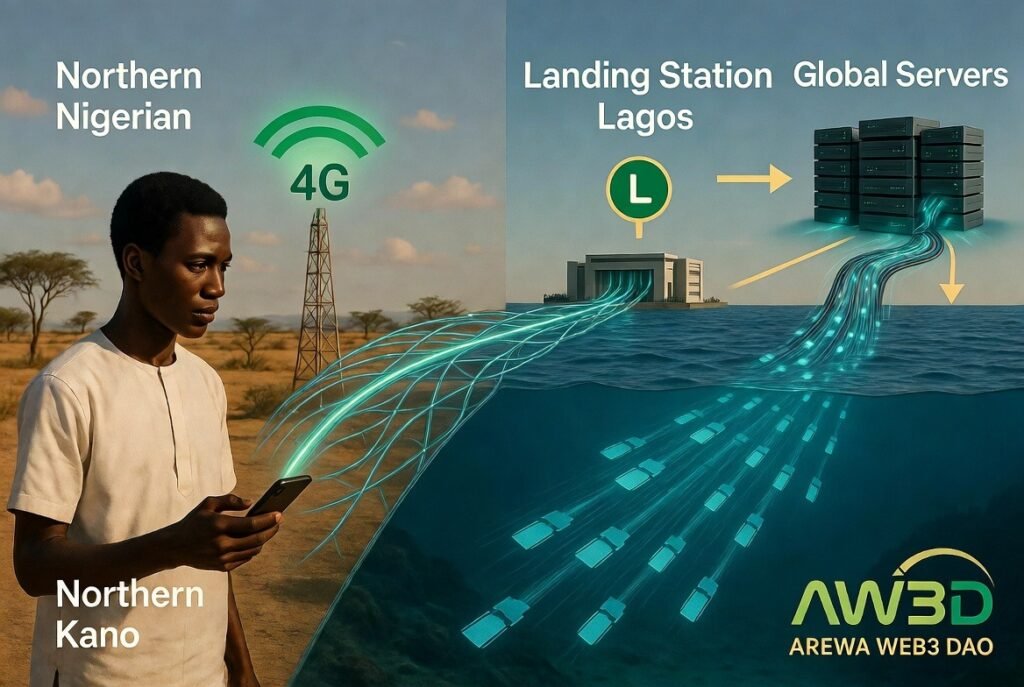
You’re in Kaduna. You open Instagram.
Feels instant, right?
Here’s what actually happens behind the scenes:
- Your phone sends a signal to the nearest 4G tower
- That tower hands it off to your provider’s core network
- Your request travels through fiber lines across the country—usually heading toward Lagos
- It reaches a submarine cable landing station
- From there, it shoots across the ocean
- It connects to a server abroad (often in Europe or the U.S.)
- The response travels all the way back through the same route.
All of this happens in about 100–300 milliseconds.
On a good day.
If everything works.
And that “if” is where things start to fall apart.
Because every step in that chain is another point of failure.
A weak signal, a damaged fiber line, a congested network, a power outage.
It only takes one.
And that brings us back to the real issue.
The 2026 Numbers (The Honest Picture)
Let’s drop the assumptions and look at reality:
- Internet users: ~148 million
- Broadband penetration: ~53%
- Daily data usage: 41,000+ TB
- Offline population: ~27 million Nigerians
At first glance, this looks like progress.
And it is—partially.
Because Nigeria doesn’t have a capacity problem anymore.
There’s more than enough international bandwidth coming into the country.
The bottleneck isn’t getting the internet into Nigeria.
It’s moving within Nigeria.
Think of it like this: We’ve built a massive, world-class highway that leads into the country.
But the roads that should carry that traffic into cities, neighborhoods, and homes?
They’re narrow. They’re damaged. And in many places… they don’t exist at all.
So the internet in Nigeria arrives fast and then gets stuck.
Why Your Internet Keeps Failing (5 Real Problems)
This is where things get uncomfortable.
Because your internet isn’t slow for just one reason. It’s not MTN. It’s not your phone.
It’s a chain of problems stacked on top of each other.
And when one breaks, everything feels it.
1. Fiber Cuts:
Start with the foundation.
Everything—calls, banking apps, streaming—depends on fiber cables running across the country.
But, between January and August 2025 alone:
- 19,000+ fiber cuts
- Over 1,000 every single month
And these aren’t rare, dramatic events.
Most of the time, it’s painfully ordinary:
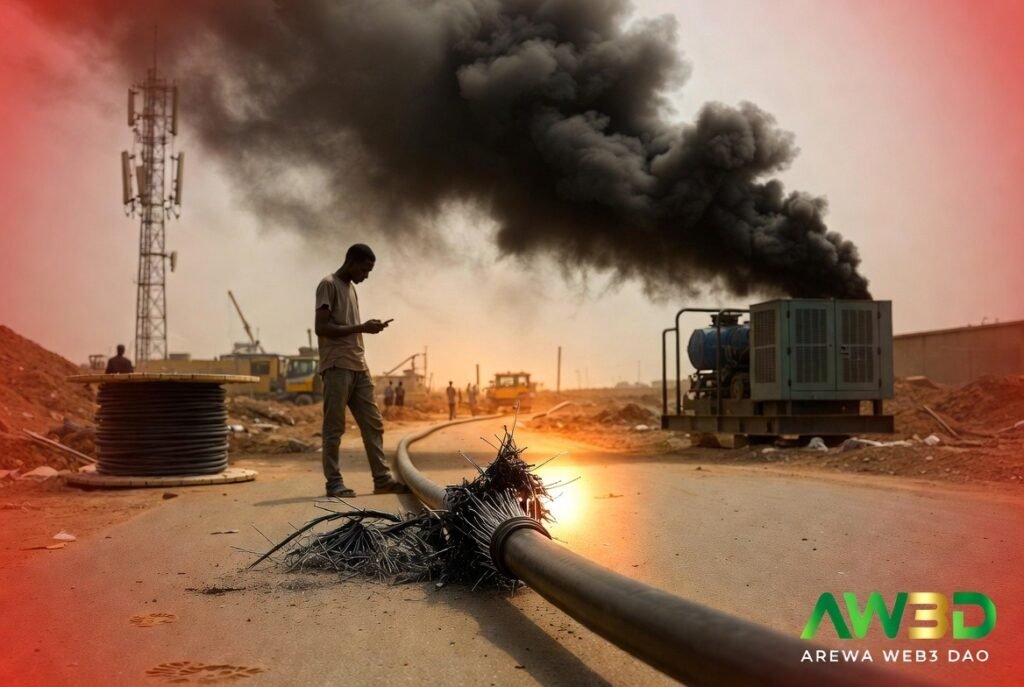
Road construction crews digging without coordination. Poorly mapped infrastructure. Or people literally cutting cables to sell as scrap.
One cut might sound small.
It’s not.
A single break can:
- Shut down connectivity in entire regions
- Force traffic to reroute across longer paths
- Slow networks nationwide
- Disrupt banking, calls, and businesses
So when your internet feels “slow”…sometimes it’s not slow.
It’s taking a detour across half the country because a cable got sliced in Ogun.
And that’s just the first layer.
2. Right-of-Way Fees
Now imagine trying to fix or expand that fragile network.
Before any telecom company can lay fiber, they have to get approval—and pay fees—to state governments.
Sounds normal.
Until you realize that every state charges differently.
Some fees are so high that building infrastructure simply doesn’t make financial sense.
So what do companies do? They avoid those areas.
And, that leads to:
- Rural communities staying disconnected
- Infrastructure clustering in already-developed cities
- Expansion slowing down where it’s needed most
And when companies do build?
They pass the cost on.
So your data plan isn’t just paying for internet in Nigeria—It’s paying for policy inefficiencies too.
Now stack that on top of an already fragile network.
3. Power Problems:
Even if the cables are intact…and even if expansion happens…
There’s another problem waiting: Power.
No electricity = no network.
It’s that simple.
So telecom towers don’t rely on the grid. They run on diesel generators—24/7.
Now layer in reality:
Fuel prices go up, the naira weakens, and inflation climbs.
Suddenly, keeping the network running becomes significantly more expensive.
That leads to:
- Higher operating costs
- Slower rollout of new infrastructure
- Reduced maintenance quality
And again, those costs don’t disappear. They move.
Straight to you.
By now, you can probably see the pattern.
But we’re not done yet.
4. The Last-Mile Gap
Let’s say everything works perfectly so far.
The cable isn’t cut, the fees are paid, the tower has power.
There’s still one final hurdle:
Getting the internet from the network… to you.
This is called the “last mile.”
And in Nigeria, it’s one of the weakest links. Why?
Because it’s the hardest and least profitable part to build.
- Rural areas generate less revenue
- Infrastructure costs are high
- Security risks are higher
- Power is still unreliable
So investment naturally flows to where returns are guaranteed.
Which creates a strange reality:
In one part of the country, people are streaming in 4K. In another, pages struggle to load on 2G.
Same country, same providers, sometimes even the same data prices…but a completely different experience.
And sitting above all of this…
Is one final layer.
5. Market Control
Here’s the part people don’t like to say out loud:
A small number of major players control critical parts of the system from international bandwidth to local distribution.
Now, to be clear, that’s not unusual in telecom. But it has consequences.
Over the years, the cost of submarine bandwidth has dropped significantly. In theory, that should mean cheaper internet for everyone.
In practice those savings don’t fully reach consumers.
Instead, you get:
- Persistently high data prices
- Limited competitive pressure
- Slower innovation
So the system stays expensive, not because it has to be…but because, structurally, it can afford to.
And when you zoom out, the picture becomes clear: Your internet isn’t failing because of one big problem.
It’s failing because of multiple small ones—stacked, connected, and reinforcing each other.
Fixing one helps. But fixing all of them is where real change begins.
The Way Forward: 7 Clear Solutions
Fixing Nigeria’s internet isn’t impossible.
But it won’t happen through one big idea or a flashy announcement.
It happens by fixing the system—layer by layer.
Here’s what that actually looks like:
1. Treat Infrastructure Like National Assets
If fiber cables are the backbone of the digital economy, then cutting one shouldn’t feel like a minor inconvenience.
It should be treated like sabotaging critical infrastructure.
That means:
- Enforcing stricter penalties for vandalism
- Actively monitoring high-risk routes
- Coordinating construction work with telecom providers
Because right now, a single careless dig can disconnect thousands—and nothing really happens.
That has to change first.
2. Map Everything (So “Accidents” Stop Happening)
You can’t protect what you can’t see.
One of the biggest reasons fiber cuts happen is simple: poor visibility.
Cables aren’t properly mapped or shared across agencies. So construction teams dig blind—and networks pay the price.
A national, accessible digital map of all fiber infrastructure changes that.
3. Fix Right-of-Way—Once and For All
Expansion shouldn’t depend on which state you’re in.
Right now, inconsistent and often excessive Right-of-Way fees slow everything down.
Some areas get built out. Others get ignored.
The fix is straightforward: One standardized, nationwide pricing model.
Lower barriers = more fiber = wider coverage.
Until that happens, infrastructure will keep growing unevenly—and so will access.
4. Solve Power at the Tower Level
Even a perfect network fails without power.
And relying on diesel in today’s economy? That’s a losing game.
The smarter shift is already obvious:
Solar + battery systems for telecom towers.
It reduces:
- Operating costs
- Downtime
- Dependence on fuel price swings
And over time, it makes the entire network more stable.
Because an always-on network can’t depend on unstable power.
5. Fix the Last Mile Through Smarter Partnerships
This is where most of the internet experience is won—or lost.
The last mile is expensive, risky, and often ignored.
So expecting private companies to solve it alone hasn’t worked.
The way forward is shared responsibility:
Public-Private Partnerships (PPPs) that:
- De-risk rural expansion
- Incentivize coverage beyond major cities
- Align profit with access
Because until the last mile improves, everything else is just potential—not experience.
6. Open Up the Network
When too few players control too much infrastructure, progress slows. Not always intentionally, but structurally.
Opening up access changes that.
Shared infrastructure means fair pricing models and that means lower barriers for smaller players.
That leads to:
- More competition
- Better pricing
- Faster innovation
Because the internet grows best when more people can build on top of it—not just a few.
7. Build Locally, Not Just Globally
Right now, a lot of Nigeria’s internet traffic leaves the country… just to come back.
That’s inefficient.
It adds latency, increases costs, and it puts more pressure on international links.
The smarter move is to build more locally:
- Nigerian apps
- Local cloud infrastructure
- Regional data centers
So data doesn’t always have to travel thousands of kilometers to work.
And this is where things start to shift—from fixing the old system… to rethinking it entirely.
A New Model: Let Nigerians Build—and Own—the Network
Right now, your role in the internet is simple: You pay for access.
That’s it.
You don’t control it. You don’t benefit from how it’s built. And when it fails—you wait.
But what if that model is the problem?
Because everything you’ve seen so far—fiber cuts, poor last-mile access, high costs, weak expansion—comes from one core structure:
A few centralized players building for millions of people.
And when they fall short, the whole system feels it.
So instead of asking, “How do we fix the system?”
There’s a more interesting question:
What if we changed who gets to build it?
Enter DePIN: A Different Way to Think About Infrastructure
DePIN—Decentralized Physical Infrastructure Networks—flips the model.
Instead of relying only on large telecom companies, it allows everyday people to participate in building real-world infrastructure.
Not theoretically. Practically.
Here’s what that looks like:
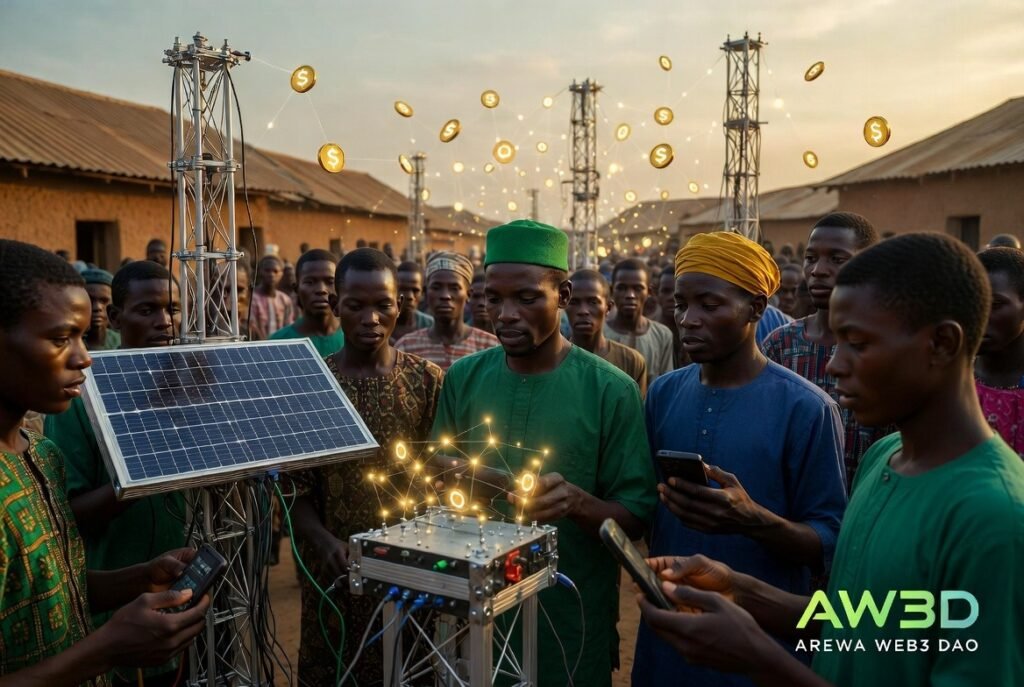
- Individuals run small network nodes (like mini access points)
- Those nodes provide real connectivity—WiFi, bandwidth, coverage
- In return, operators earn rewards for contributing to the network
- Infrastructure grows from the ground up—not just top-down
So instead of one giant system trying to serve everyone…
Thousands of smaller contributors expand the network together.
And the more people participate, the stronger—and wider—the network becomes.
This isn’t just an idea, by the way.
Projects like Grass Network are already testing and proving this model globally.
Why This Model Hits Differently in Nigeria
In some countries, DePIN is just an upgrade.
In Nigeria, it’s an opportunity.
Because the conditions are already there:
- Centralized systems that struggle under pressure
- Large areas still underserved or completely disconnected
- A young, tech-aware population
- Strong entrepreneurial instincts
In other words, the exact environment where a bottom-up model can thrive.
Instead of waiting for perfect rollout plans or policy alignment, people can start building coverage where they are.
Neighborhood by neighborhood. Community by community.
And this is where things shift from fixing problems… to creating leverage.
This is the real transition:
From consuming the internet…to contributing to it.
From paying for access… to earning from infrastructure.
From waiting on upgrades…to enabling them.
Because when more people can build, the network doesn’t just grow—it adapts faster, reaches further.
And it becomes more resilient by design.
Where AW3D Comes In
This is exactly the direction Arewa Web3 DAO (AW3D) is pushing.
Not just awareness or just theory.
But a shift in mindset: Nigerians shouldn’t only use the internet.
They should help build it, own parts of it, and benefit from it.
Especially in regions where traditional infrastructure has been slow to reach.
Because the future of connectivity here won’t come from one breakthrough—it’ll come from many small nodes, connected by people who decided to participate.
So What Do You Do With This?
This isn’t one of those “interesting, but nothing changes” ideas.
There are real entry points:
- Understand how internet infrastructure actually works
- Pay attention to outages—and what causes them
- Support smarter policies and better coordination
- Explore community-driven network models
- Start learning about Web3 and DePIN
Because the shift is already happening.
The only question is whether you stay a user…or become part of the network itself.