 Simisola Owolabi
 Every day, millions of Nigerians experience the frustration of unreliable digital systems: slow international banking transfers that take days, disputed land ownership with conflicting records, fake drugs in pharmacies, electoral results that nobody trusts, and internet services that fail when you need them most.
These aren’t just inconveniences—they’re symptoms of a deeper problem with how our digital infrastructure is built and controlled.
What if there was a way to create digital systems that don’t depend on one central authority to function? What if records couldn’t be secretly altered, transactions couldn’t be reversed by a single person’s decision, and everyone could verify the truth without asking permission from a gatekeeper?
This is exactly what blockchain technology makes possible.
The Foundation: Why We Need Blockchain
The Problem of Trust
For any interaction between humans to work reliably, trust has always played a critical role. Throughout history, we’ve relied on intermediaries—banks, governments, religious leaders, traditional rulers, and other authorities—to act as trusted third parties in our transactions and record-keeping.
However, reality shows us that these trusted parties often prove untrustworthy, especially when it matters most. Records disappear. Documents get altered. Officials demand bribes. Systems fail during peak demand—not by accident, but because they were deliberately built to substandard specifications due to corruption.
In Nigeria specifically, we face:
- Infrastructure deliberately weakened by corruption – Systems built to fail so contracts can be renewed
- Centralized control that breeds manipulation – Single points of failure that authorities can exploit
- Low trust in institutions – From land registries to electoral bodies, confidence is minimal
- Expensive, slow services – High fees for basic transactions because intermediaries extract maximum value
The question became clear: Can we create systems that don’t rely on these traditional custodians of trust?
This is where blockchain comes into play.
What Is Blockchain? A Simple Explanation
Imagine you have a notebook that everyone in your class can see and write in, but once something is written, nobody can erase it.
Every time someone trades cards or gives someone a sticker, all your classmates write it down in the same notebook. All records match perfectly, so cheating becomes almost impossible.
That’s blockchain.
At its core, blockchain is a special kind of computer system that:
- Keeps records in many places at once – So no single person or company controls everything
- Prevents tampering – Once data is added, it’s extremely difficult to change without everyone else agreeing
- Let’s computers agree on what’s true – This is called decentralization
- Creates permanent history – Everything that happens is recorded forever in the correct order
The internet we use today feels broken to many Nigerians:
- Websites slow down during peak demand
- Big tech companies control everything
- Trust is low when dealing with land records, money transfers, or voting systems
- Services are expensive and unreliable
Blockchain offers a different way—one in which a network of computers verifies information together, rather than a single central server in some far-off office making all the decisions.
That’s why understanding what blockchain is matters on a personal level. It’s not just technology—it’s a different way of organizing digital systems that doesn’t require you to trust any single authority.
How Blockchain Actually Works
Let’s break down the mechanics step by step:
1. Blocks Are Like Pages in a Shared Notebook
Each “block” is like a page that contains a list of things that happened:
- A payment from one person to another
- A record of who owns a document
- A transfer of farm produce from the farmer to the market
- A vote cast in an election
Every transaction or record gets written down with a timestamp and other identifying information.
2. The Chain Is the Order of Events
Once a page (block) is full, a new page is added after it and securely linked using advanced encryption. Everyone knows the exact order in which things happened because each new block references the previous one.
This creates an unbreakable chain of history—hence “blockchain.”
3. Many People Keep Copies of the Book
Instead of one person or organization keeping the only copy of the notebook, thousands of computers around the world (or across Nigeria) each keep their own identical copy.
When someone tries to add a new page, all these computers check it against their copies. If the majority agrees it’s valid, the new page gets added to everyone’s copy simultaneously.
This means:
- No single point of failure – If one computer goes down, thousands of others continue working
- No single point of control – No one person can secretly change the records
- Transparent verification – Anyone can check the history at any time
4. No Erasing Allowed
Once something is written into the blockchain, it becomes part of permanent history. To change it, you would need to:
- Convince the majority of all computers in the network to agree
- Recalculate all the encryption for that block and every block after it
- Do this faster than new blocks are being added
This is mathematically almost impossible for large, well-distributed blockchains. The history can’t be hidden, deleted, or secretly altered.
5. Consensus Makes It Work
The computers in the network use special rules (consensus mechanisms) to agree on what’s true:
- Proof of Work – Computers solve complex math problems to earn the right to add blocks (Bitcoin uses this)
- Proof of Stake – Computers that hold tokens get selected to validate blocks (Ethereum now uses this)
- Other methods – Different blockchains use variations designed for speed, energy efficiency, or other goals
This consensus process is what replaces the need for a central authority like a bank or government agency to decide what’s valid.
How Blockchain Solves Nigeria’s Real Problems
Now that you understand what blockchain is fundamentally, let’s examine how it addresses specific Nigerian challenges.
Note: The applications of blockchain technology extend far beyond what we can cover in this article.
From intellectual property protection to insurance claims processing, from real estate tokenization to decentralized energy grids, blockchain’s potential use cases are vast and constantly expanding.
We’ve focused here on the most immediately relevant applications for everyday Nigerians, but this represents just a fraction of what’s possible.
1. Transparent and Secure Voting Systems
The Problem: Electoral fraud, vote manipulation, result tampering, and lack of trust in announced results have plagued Nigerian democracy for decades. Results declared by INEC often face immediate rejection because citizens cannot independently verify them.
The Blockchain Solution:
- Each vote is recorded as a transaction on the blockchain immediately when cast
- Voters can verify their vote was counted without revealing who they voted for
- Results are calculated automatically from the immutable record
- Anyone can audit the total votes without needing permission from INEC
- Tampering becomes visible immediately because the blockchain would show the alteration attempt
Real Impact: Transparent voting systems restore trust in democracy. Citizens don’t have to wonder if their vote counted or if results were manipulated in a back room. The blockchain shows everyone the same, verifiable truth.
2. Immutable Medical and Health Records
The Problem: Nigerian patients often carry physical folders of medical records between hospitals. Records get lost, damaged, or altered. Doctors can’t access patient history in emergencies. Fake vaccination cards and health certificates circulate freely. Medical research lacks reliable data.
The Blockchain Solution:
- Patient medical histories stored on blockchain are accessible to authorized healthcare providers anywhere
- Records cannot be altered retroactively, preventing fraud
- Patients control who accesses their data through cryptographic permissions
- Vaccination records, drug prescriptions, and test results are permanently verifiable
- Research data from multiple hospitals can be aggregated without compromising patient privacy
Real Impact: A patient who collapses in Lagos has their complete medical history—allergies, medications, previous surgeries—instantly available to doctors, even if they usually receive care in Kano. Fake yellow fever certificates for international travel become impossible. Clinical trials have trustworthy data.
3. Transparent Land Records and Property Ownership
The Problem: Land disputes are epidemic in Nigeria because:
- Records are manual, incomplete, or deliberately altered
- Multiple people claim ownership of the same plot with “valid” documents
- Government officials manipulate records for bribes
- Court cases drag on for decades
- Property transactions are slow, expensive, and risky
The Blockchain Solution:
- Every land title is recorded on the blockchain with complete ownership history
- Changes in ownership are transparent and permanent
- Anyone can verify who owns a piece of land by checking the blockchain
- Fraudulent documents are immediately exposed because they don’t match the blockchain record
- Property sales can happen faster because both parties trust the record
Real Impact: A buyer can verify land ownership in minutes from their phone instead of spending months investigating and still getting defrauded. Family inheritance disputes have a clear, tamper-proof record. Land becomes a reliable asset for business collateral because ownership is certain.
4. Efficient Logistics and Supply Chain Management
The Problem:
- Fake products (medicines, foods, electronics) flood markets
- Goods disappear between the factory and the store
- Farmers can’t prove their produce is organic or ethically sourced
- Transporters and distributors manipulate records
- Customs and import documentation are opaque and slow
- Cold chain breaks for temperature-sensitive goods without detection
- Driver and vehicle documentation is easily forged
- Drug regulatory approval status is unclear and manipulated
- Tracking pharmaceutical compliance across the supply chain is nearly impossible
The Blockchain Solution:
- Every step in a product’s journey is recorded: manufacturing, inspection, transport, storage, and retail
- Smart sensors can automatically record temperature, location, and handling
- QR codes link physical products to their blockchain record
- Consumers can scan a product and see its complete journey from origin to shelf
- Tampering at any stage becomes visible in the permanent record
- Automated payments are released when delivery conditions are verified
- Digital car and driver registry: Vehicle ownership, insurance, driver’s licenses, and transport credentials verified on blockchain, making it impossible to use fake or expired documents
- Drug regulatory tracking: NAFDAC approval status, manufacturing licenses, batch certifications, and compliance records are permanently recorded and instantly verifiable at every point in the pharmaceutical supply chain
- Real-time compliance verification: Regulators can instantly check if drugs in circulation have proper approvals, haven’t been recalled, and meet quality standards
Real Impact: A mother buying infant formula can scan the package and verify it came from the legitimate manufacturer, was stored at proper temperatures, and wasn’t counterfeit. Pharmaceutical companies can prove their drugs are genuine and have valid NAFDAC approval.
Transport companies can instantly verify driver credentials and vehicle documentation, reducing accidents from unqualified drivers. Regulators can track drug approval status from manufacturing through distribution to retail, catching counterfeit or unapproved medications before they reach patients. Export records for agricultural products become instantly verifiable, opening international markets.
5. Verifiable Student Academic Records
The Problem:
- Fake certificates and diplomas are widespread
- Employers spend time and money verifying academic credentials
- Students applying abroad face long verification processes
- Transcript requests from universities take weeks or months
- Records get “lost” and require bribes to “find.”
- Academic fraud damages the reputation of legitimate graduates
The Blockchain Solution:
- Universities issue certificates and transcripts as blockchain tokens
- Employers can verify credentials instantly without contacting the university
- Students control access to their academic records
- International institutions can verify Nigerian degrees immediately
- Fake certificates are immediately exposed because they lack blockchain verification
- Complete academic history from primary school through university exists in one verifiable record
Real Impact: A graduate applying for a job abroad shares a cryptographic link. The employer verifies their degree in 30 seconds instead of waiting 3 months for university confirmation. Fake degree mills lose their market because employers can verify authenticity instantly. Merit-based hiring becomes easier and fairer.
6. Faster and Cheaper Money Transfers
The Problem:
- International remittances have high fees (often 5-15% of the amount sent)
- Transfers take 3-7 business days
- Banks and payment companies extract maximum value as intermediaries
- Many Nigerians lack access to traditional banking
- Cross-border payments require multiple currency conversions
The Blockchain Solution:
- Cryptocurrency transfers happen in minutes, not days
- Fees are typically under 1% of the transfer amount
- No intermediary banks needed—sender to receiver directly
- Works 24/7, including weekends and holidays
- Only requires internet access and a smartphone, no bank account needed
Real Impact: A family member abroad sending ₦100,000 pays ₦500 in fees instead of ₦10,000, and the money arrives in 15 minutes instead of 5 days. Small business owners can pay international suppliers directly without expensive bank charges. Workers in the diaspora can support families back home more efficiently.
7. Transparent Supply Chains for Agriculture
The Problem:
- Farmers get cheated on produce quality and prices
- Middlemen manipulate weights and grades
- Organic or fair-trade claims cannot be verified
- Produce rots in transport due to poor coordination
- Export markets demand proof of origin that farmers can’t provide
- Food contamination sources are difficult to trace
The Blockchain Solution:
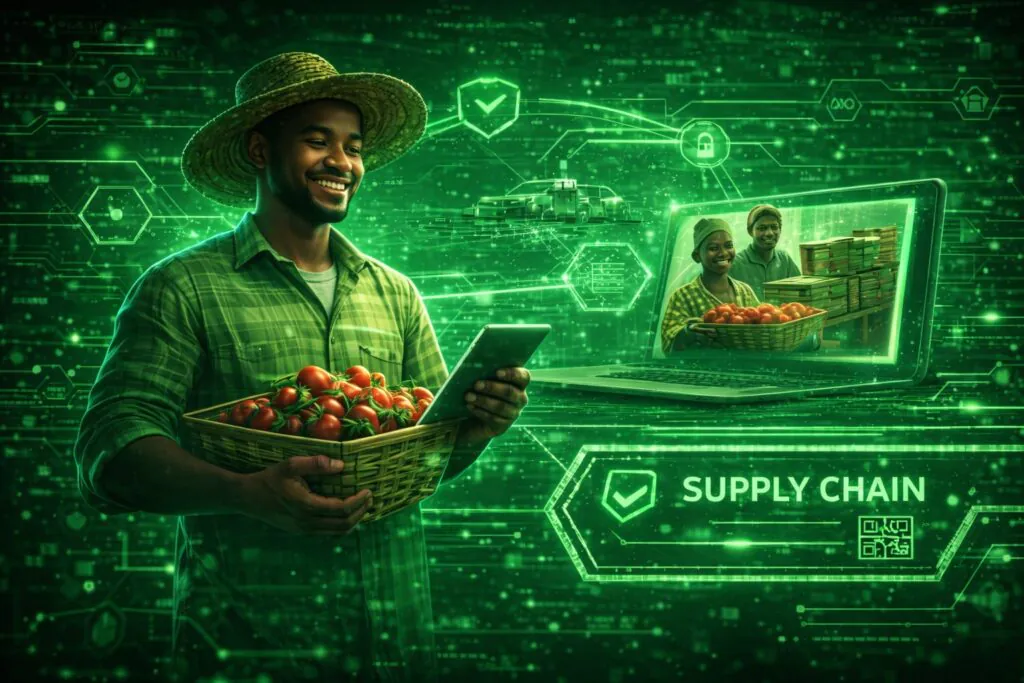
- Farm-to-market journey is recorded at each stage
- Quality certifications are timestamped and immutable
- Smart contracts automatically release payment when delivery is confirmed
- Consumers can verify organic/fair-trade claims
- Contamination can be traced to specific farms or batches in minutes
- Market prices become transparent to farmers
Real Impact: A tomato farmer in Jos can prove to exporters that their produce is organic and was harvested yesterday, commanding premium prices. When contaminated produce appears in a market, health officials identify the source farm in hours instead of weeks. Middlemen can’t manipulate records because farmers, transporters, and markets all see the same blockchain data.
8. Digital Identity and Security
The Problem:
- Multiple government IDs (NIN, voter card, driver’s license, international passport) with inconsistent data
- Identity theft and fraud are common
- Accessing government services requires showing physical documents repeatedly
- Citizens have no control over who accesses their personal information
- Refugees or displaced persons lose all identity documentation
- Know-Your-Customer (KYC) processes are repeated for every new service
The Blockchain Solution:
- One verified digital identity controlled by the citizen
- Selective disclosure—show only the information needed for each transaction
- Government agencies, banks, and service providers can verify identity cryptographically
- Identity exists independently of physical documents
- Complete audit trail of who accessed your information and when
- Cross-border identity verification becomes instant
Real Impact: Opening a bank account requires showing verified age and address from your blockchain identity—no physical documents, no photocopies, completed in minutes. You can prove you’re over 18 for age-restricted purchases without revealing your exact birthdate or address. Internally displaced persons maintain verified identity even after losing all physical documents.
9. Legal Proceedings and Documentation
The Problem:
- Court documents get lost, altered, or “disappear”
- Case files are incomplete or manipulated
- Property deeds, wills, and contracts are disputed because originals can’t be verified
- Legal precedents are difficult to research and reference
- Notarization and attestation require expensive intermediaries
- Evidence tampering undermines justice
- Legal proceedings drag on for decades, partly due to documentation disputes
The Blockchain Solution:
- All legal documentsare stored with cryptographic timestamps proving when they were created
- Smart contracts can execute wills, agreements, and settlements automatically when conditions are met
- Evidence chains of custody are transparent and immutable
- Court rulings and case histories are permanently recorded and searchable
- Document notarization happens on blockchain, eliminating notary fraud
- Property transfers and inheritance records are dispute-proof
- Legal professionals can reference precedents with certainty about authenticity
Real Impact: A family inheritance dispute is resolved in months instead of decades because the deceased’s blockchain-recorded will is undeniably authentic and timestamped. Property buyers don’t fear fake deeds because ownership transfer is cryptographically verified.
Evidence presented in court has a complete, tamper-proof chain of custody from collection to presentation. Business contracts execute automatically when conditions are met, reducing litigation over “he said, she said” disputes.
Why Blockchain Succeeds Where Traditional Systems Fail
You might ask: “If databases already exist, why bother with blockchain?”
Excellent question. For many applications, a traditional database works fine. But blockchain excels when:
1. You Don’t Fully Trust the Other Party
If a buyer and seller don’t know each other, blockchain creates a shared record both can trust without trusting each other.
2. You Need Shared, Unchangeable History
Banks and governments struggle with fraud and outdated records—blockchain prevents silent tampering because any change would be visible to everyone.
3. You Want Transparency Without a Central Gatekeeper
This builds trust across communities and businesses without requiring everyone to trust a single authority.
4. The Central Authority Is the Problem
When the institution that controls the database is corrupt or incompetent, giving them more database tools doesn’t help. Blockchain removes its exclusive control.
Example: Nigeria’s land title disputes come from opaque records and corruption. A centralized government database doesn’t solve this if officials can still alter entries for bribes.
Blockchain ensures everyone can verify the ownership history without trusting any single person or agency. The network itself becomes the authority through mathematics and consensus, not political power.

Understanding Nigeria’s “Broken Internet”
When Nigerians talk about a broken internet, they often mean:
- Slow or unreliable networks – Infrastructure that fails during peak usage
- Centralized control – Big companies or authorities deciding what works and what doesn’t
- Lack of trust – Digital records that can be manipulated
- High fees and slow services – Intermediaries extracting maximum value
- Single points of failure – When the central system goes down, everything stops
How Blockchain Addresses These Issues
Blockchain doesn’t fix internet speeds directly—that requires physical infrastructure investment. But it fundamentally changes how data and records are trusted and shared:
Traditional System:
- One organization controls the records
- If their server goes down, data is unavailable
- If officials are corrupt, records can be altered
- Users must trust the central authority completely
- Single point of failure and single point of corruption
Blockchain System:
- Information stored across thousands of computers
- No single point of failure—if one goes down, the system continues
- Records are transparent and verifiable by anyone
- Trust comes from mathematics and consensus, not authority
- Manipulation requires controlling the majority of the network (practically impossible)
This model fixes the parts of our “broken internet” experience where:
- Data disappears or becomes unavailable
- Records get hacked or altered
- Changes happen without permission or notification
- We have to trust authorities who have proven untrustworthy
Imagine if Nigeria’s government agencies, banks, hospitals, and schools recorded their most important data on shared, immutable blockchain ledgers. The problems caused by centralized failures and corruption would shrink dramatically. That restoration of trust fixes a fundamental part of what feels broken in our digital infrastructure.
This is why understanding blockchain technology in Nigeria isn’t just academic—it’s about building systems that everyone can trust without waiting for a single authority to become honest and competent.
Real Examples of Blockchain Use in Nigeria Today
Blockchain isn’t just a theory—Nigerians are already building and using these systems:
1. Cryptocurrency Exchanges and Digital Payments
Companies: Quidax, Luno, Bundle Africa, Patricia, Yellow Card
Nigeria is one of Africa’s largest cryptocurrency markets. Millions of Nigerians use blockchain-based platforms to:
- Send and receive international payments
- Save money in stable cryptocurrencies to hedge against naira devaluation
- Trade digital assets
- Access financial services without traditional bank accounts
Every transaction happens on public blockchains like Bitcoin or Ethereum, where anyone can verify the network’s state.
2. Anti-Counterfeit and Supply Chain Verification
Company: Chekkit
Chekkit uses blockchain to combat counterfeit goods and make supply chains transparent. Consumers can scan products to verify authenticity and see the product journey from manufacturer to retailer.
Company: DrugStoc
DrugStoc tackles fake medicine—a deadly problem in Nigeria—by using blockchain to track pharmaceuticals from factory to pharmacy. This creates an immutable record that exposes counterfeit drugs immediately.
3. Agriculture and Fair Trade
Multiple Nigerian startups are applying blockchain to:
- Track farm produce from field to market
- Verify organic and fair-trade certifications
- Create transparent pricing for farmers
- Build trust among farmers, transporters, and buyers
- Ensure food safety through traceable supply chains
These systems help Nigerian farmers access premium markets (both local and international) by proving the quality and origin of their produce.
4. Financial Inclusion and DeFi
Blockchain enables Nigerians without traditional bank accounts to:
- Access savings and lending services through decentralized finance (DeFi)
- Participate in global financial markets
- Store value in ways that can’t be frozen or seized arbitrarily
- Build credit history through on-chain transaction records
5. Digital Content and Creative Economy
Nigerian artists, musicians, and content creators use blockchain to:
- Prove ownership of digital art through NFTs (Non-Fungible Tokens)
- Receive direct payments from global audiences without intermediaries
- Create verifiable scarcity for digital creations
- Build communities around their work with token-based access
What Blockchain Means for Every Nigerian

You don’t need to be a coder or tech expert to benefit. Here are tangible ways blockchain can improve daily life:
For Everyone:
- Cheaper remittances – Send and receive money internationally with minimal fees
- Safer digital money storage – Use wallets that you control, not banks
- Less fraud in trade – Blockchain tracking ensures product authenticity
- Immutable records – Certificates, IDs, and important documents that can’t be faked or lost
- Transparent governance – If public spending is recorded on blockchain, citizens can verify how funds are used
For Students:
- Verifiable academic credentials that can’t be faked
- Instant transcript sharing with employers or universities abroad
- Access to global educational content and credentials
- Build skills for emerging tech careers
For Entrepreneurs:
- Access to global markets without traditional banking barriers
- Transparent supply chains that build customer trust
- Smart contracts that enforce agreements automatically
- Cheaper, faster international transactions
For Workers:
- Receive wages in stable cryptocurrencies if the local currency is volatile
- Build verifiable work history on blockchain
- Access global freelance opportunities with crypto payments
- Protect savings from currency devaluation
For Farmers:
- Prove product quality and origin to access premium markets
- Receive fair prices through transparent marketplaces
- Get paid automatically when delivery is verified
- Access credit based on farming history
These blockchain benefits make the digital world more reliable—like having a rulebook everyone respects and can verify, where no single authority can cheat the system.
Why Nigeria Is Positioned for Blockchain Leadership
Nigeria has unique advantages for blockchain adoption:
1. Massive Youth Population
- Over 60% of Nigerians are under 25
- Young people are more willing to adopt new technologies
- The digital-native generation is comfortable with cryptocurrency and Web3
2. Strong Entrepreneurial Culture
- Nigerians are natural problem-solvers and hustlers
- History of building solutions despite infrastructure challenges
- Growing tech ecosystem in Lagos, Abuja, Port Harcourt, and other cities
3. High Mobile Internet Usage
- Smartphone penetration is rapidly increasing
- Mobile-first mindset makes crypto wallets natural
- Used to conducting business via phones
4. Real Problems That Blockchain Solves
- Currency instability makes cryptocurrency attractive
- Broken institutions create demand for trustless systems
- Expensive remittances make cheap blockchain transfers valuable
- Infrastructure gaps make decentralized systems appealing
5. Growing Ecosystem Support
- Government agencies discussing blockchain strategies
- Tech hubs offering blockchain training programs
- Startups applying blockchain to local problems
- International blockchain companies are establishing Nigerian operations
6. Proven Adoption Leadership
- Nigeria consistently ranks in top 10 countries globally for cryptocurrency adoption
- African blockchain hub attracting investment and talent
- Regional leadership in fintech innovation
The combination of necessity, youth, entrepreneurship, and mobile infrastructure positions Nigeria to be a blockchain leader, not just in Africa but globally.
The Skills Gap: Blockchain Jobs and Opportunities
Blockchain is creating entirely new career paths, and Nigeria’s fast-growing tech scene desperately needs people who understand:
Technical Skills:
- Blockchain Development – Building decentralized applications (dApps)
- Smart Contract Programming – Writing self-executing agreements (Solidity, Rust)
- Cryptography – Understanding the security foundations
- Node Operation – Running and maintaining blockchain infrastructure
- DeFi Development – Creating decentralized financial products
Non-Technical Skills:
- Community Management – Building and moderating Web3 communities
- Content Creation – Explaining blockchain to non-technical audiences
- Business Development – Finding blockchain use cases for traditional businesses
- Legal and Compliance – Understanding blockchain regulation
- Product Management – Designing blockchain-based products
- Marketing and Growth – Growing blockchain projects and DAOs
Real Career Opportunities:
For Developers:
- Smart contract developer: $60,000-$150,000+ USD annually (remote work)
- Blockchain protocol engineer: $80,000-$200,000+ USD
- DApp developer: $50,000-$120,000+ USD
- Security auditor: $70,000-$180,000+ USD
For Non-Developers:
- Community manager: $30,000-$80,000+ USD
- Technical writer: $40,000-$90,000+ USD
- Product manager: $60,000-$140,000+ USD
- Business development: $50,000-$120,000+ USD
For Entrepreneurs:
- Build blockchain solutions for Nigerian problems
- Create local cryptocurrency exchanges or payment systems
- Develop supply chain tracking for agriculture
- Launch NFT platforms for African creators
- Start blockchain education platforms
Where to Learn:
Platforms like AW3D (Arewa Web3 DAO) offer structured learning that takes you from a complete beginner to a skilled blockchain practitioner. The curriculum covers:
- Blockchain fundamentals explained without technical jargon
- Practical wallet setup and Web3 interaction
- Understanding DeFi, NFTs, and decentralized applications
- Node operation and infrastructure participation
- Building blockchain-based businesses
- Community governance and DAO participation
This isn’t just education—it’s positioning yourself for real Web3 job opportunities in a rapidly growing global industry.
Whether you’re interested in coding, digital infrastructure, community building, content creation, or entrepreneurship, blockchain knowledge opens doors that didn’t exist five years ago.
Challenges and Realistic Expectations
Blockchain is powerful, but it’s not magic. Understanding the limitations is as important as knowing the benefits:
Current Challenges in Nigeria:
1. Infrastructure Limitations
- Unstable electricity makes running blockchain nodes difficult
- Expensive and unreliable internet connectivity
- Limited access to hardware for mining or validation
2. Regulatory Uncertainty
- Central Bank restrictions on cryptocurrency banking
- Unclear legal framework for blockchain businesses
- Tax treatment of crypto transactions is ambiguous
3. Knowledge Gap
- Most Nigerians don’t understand how blockchain works
- Scams and “get-rich-quick” schemes damage reputation
- Quality education resources are scarce
4. Scalability Issues
- Many blockchains are slow and expensive during high usage
- The energy consumption of some blockchains (like Bitcoin) is high
- User experience is still complex for non-technical people
What Blockchain Cannot Do:
- Fix corruption directly – Technology enables transparency, but people must demand it
- Replace all intermediaries – Some human judgment and intervention will always be needed
- Solve poverty – It’s a tool, not a miracle solution
- Work without internet – Blockchain requires connectivity
- Eliminate all fraud – Scammers will find new methods; vigilance is still required
Realistic Path Forward:
Short Term (1-3 years):
- Focus on education and skill development
- Build small-scale pilot projects
- Establish clearer regulations
- Improve infrastructure incrementally
Medium Term (3-7 years):
- Deploy blockchain for specific use cases (land records, voting, health records)
- Grow local blockchain development talent
- Integrate blockchain into existing systems
- Create sustainable blockchain businesses
Long Term (7+ years):
- Blockchain becomes standard infrastructure
- Most Nigerians understand and use blockchain daily
- Nigeria becomes African blockchain hub
- Export blockchain solutions to other developing nations
The key is patience, education, and focusing on solving real problems rather than chasing hype.
Getting Started: Your Next Steps
Understanding blockchain is just the beginning. Here’s how to move from knowledge to action:
1. Learn the Fundamentals
- Start with quality educational resources like AW3D’s curriculum
- Understand blockchain basics before jumping into cryptocurrency trading
- Learn by doing—set up a wallet, make a small transaction, explore blockchain explorers
2. Identify Your Path
- Technical path: Learn programming languages like Solidity, JavaScript, or Rust
- Business path: Study how blockchain applies to your industry
- Community path: Join Web3 communities and contribute
- Creative path: Explore NFTs and digital content creation
3. Build Practical Experience
- Participate in blockchain networks (run a node, stake tokens)
- Contribute to open-source blockchain projects
- Create content explaining blockchain to others
- Attend Web3 events and hackathons
4. Stay Safe
- Never invest more than you can afford to lose
- Use secure wallets and backup your recovery phrases
- Be extremely skeptical of promises of guaranteed returns
- Verify everything—scams are prevalent in the crypto space
5. Think Long-Term
- Blockchain is infrastructure, not a get-rich-quick scheme
- Focus on building skills and solving problems
- Network with other builders and learners
- Be patient—meaningful change takes years, not weeks
Resources to Explore:
Educational Platforms:
- AW3D (Arewa Web3 DAO) – Comprehensive Web3 education from zero to founder level
- Blockchain Council – Professional certifications
- CryptoZombies – Learn smart contract development through games
- Bankless – Understanding decentralized finance
Nigerian Communities:
- Local blockchain meetups in Lagos, Abuja, Port Harcourt
- Web3 developer groups
- Cryptocurrency trading communities
- NFT creator collectives
Practice Platforms:
- Testnet Faucets – Get free test cryptocurrency to practice
- Remix IDE – Write and test smart contracts
- MetaMask – Popular Web3 wallet
- Etherscan – Explore Ethereum blockchain transactions
Conclusion: Building the Future We Need
Blockchain in Nigeria is more than just a technology.
It’s a practical response to the broken systems we deal with every day. It’s a way to create digital infrastructure that doesn’t require blind trust in institutions that have repeatedly failed us.
From transparent voting systems to secure health records, from verifiable academic credentials to efficient supply chains, blockchain offers concrete solutions to problems that have plagued Nigeria for decades.
The Vision:
Imagine a Nigeria where:
- Elections produce results that everyone trusts because votes are transparently recorded on a blockchain
- Land disputes decrease dramatically because ownership records are immutable and public
- Fake drugs disappear because supply chains are fully traceable
- Students’ academic records follow them seamlessly from primary school through university and into careers
- Small businesses access global markets without expensive intermediaries
- Remittances from the diaspora arrive in minutes with minimal fees
- Government spending is transparent, and citizens can verify how funds are used
This isn’t fantasy—it’s achievable with blockchain technology and the will to implement it.
Your Role:
Every major technological shift creates winners and losers. The winners are those who:
- Learn early
- Build practical skills
- Solve real problems
- Think long-term
- Share knowledge with others
The losers are those who:
- Dismiss new technology without understanding it
- Wait for everything to be perfect before learning
- Chase hype without building substance
- Keep waiting for someone else to fix the system
Which will you be?
Moving Forward:
While Nigeria still needs stronger internet infrastructure and clearer regulations to unlock blockchain’s full potential, the technology is already helping solve real challenges where traditional systems struggle.
As more Nigerians learn what blockchain is and how to build with it, platforms like AW3D provide the structured education and community support needed to move from consumer to contributor to builder.
The path from broken systems to trusted infrastructure won’t be instant, but it’s already beginning. The question isn’t whether blockchain will transform how digital systems work in Nigeria—it’s whether you’ll be part of building that transformation.
The notebook is open. The pen is in your hand. What will you write into Nigeria’s blockchain future?
Start your blockchain learning journey today with AW3D : Learn Web3 and blockchain skills, from zero knowledge to founder-level execution.
